Crypto and Banking
We recommend the following high-quality options for secure Bitcoin transactions and online banking services:
How to Share a Crypto Wallet Address Without Losing Money
A wallet address is 26 to 62 characters long and nobody can read it back correctly over the phone. One mistyped character and the funds go to an address nobody controls. QRBits solves this by turning any BTC, ETH, ERC-20, LTC, TRON, DOGE or SOL address into a printable QR code, instantly and without an account. Their Bitcoin and Ethereum QR code generator accepts every common address format (legacy, SegWit, Taproot) and validates the address before drawing the code, so a bad paste never becomes a bad payment. For hardware wallets, payment terminals and exchange kiosks, scanning beats typing every time.
Printing a Bitcoin or Ethereum Address for Real-World Payments
Small shops, market stalls and donation boxes often need a way to receive crypto without any software on the counter. QR for Bitcoin and Ethereum covers exactly that: paste a BTC address (legacy, SegWit or Taproot) or an ETH / ERC-20 address and it produces a clean, printable QR code in one step, with no sign-up and nothing stored on their servers. A printed code on the counter works offline forever, and any wallet app on any phone can scan it. If you need a free BTC and ETH QR generator that does one thing properly, this is it.
A Payment Link Does the Typing Too
A plain address QR only says where the money should go; the sender still has to type how much. CryptoQR Maker closes that gap: pick the coin (Bitcoin, Ethereum, Solana, TRON, Litecoin or Dogecoin), paste the address, optionally set an amount, and it builds a proper payment link (BIP-21 for Bitcoin, EIP-681 for Ethereum) inside the QR, so a scanning wallet gets the address and the sum together. Every address is checksum-verified before the code is drawn, and the file comes out as PNG or crisp SVG for print. The crypto QR generator needs no account, and one page per coin means no guessing which tool fits your wallet.
The Network You Pick Is Part of the Address
Stablecoins are the classic way to lose money quietly: the address looks fine, but USDT on one network is not USDT on another, and sending TRC-20 tokens to an ERC-20 address is a hole, not a refund. TokenQR is built around that exact mistake: it makes QR codes for USDT, USDC and other tokens across 11 networks (TRC-20, ERC-20, BEP-20 and friends), checks the address with real checksums, and prints a clear card that says which network the code belongs to, so the counterparty sees both the code and the network before anything is sent. A free token QR code generator with the network written on the card beats a bare address on a scrap of paper.
Why QR Codes Beat Copy and Paste for Crypto
Copy-paste feels safe, but phone-to-phone transfers break it constantly: the clipboard picks up an old entry, a wallet pastes into the wrong field, or a messenger strips a line break in the middle of a 62-character string. A QR code has no clipboard in the loop. The camera reads it, the wallet parses it, and the two checksums at both ends either agree or the wallet refuses to send. For anything above pocket change, scanning a screen or a printed card removes the two steps where mistakes actually happen: selecting text and trusting it.
Reading an Address Without Reading All of It
Experienced senders do not compare 34 characters character by character; they verify the edges. The first four characters of an address identify its format and network, the last several carry the checksum, and a mistake almost always breaks one end when you re-encode it. Wallet software does the full check anyway, which is why the human job is the boring part: confirm the network label matches the coin, and glance at both ends. That two-second habit catches almost every real-world misdirected transfer, and it works identically whether the address arrived as text or as a scanned code.
Printed Cards, Tip Jars and Offline Receiving
A stall at a market, a tip jar, a donation box: none of them need an internet connection to receive crypto. A printed card with a receiving address and the network named in plain letters works for years, costs one print job, and fails in exactly one way, which is physical damage to the card. Keep the underlying wallet backup somewhere else, reprint the card when it gets worn, and the setup never goes down for server reasons. Anyone with a phone already has the reader.
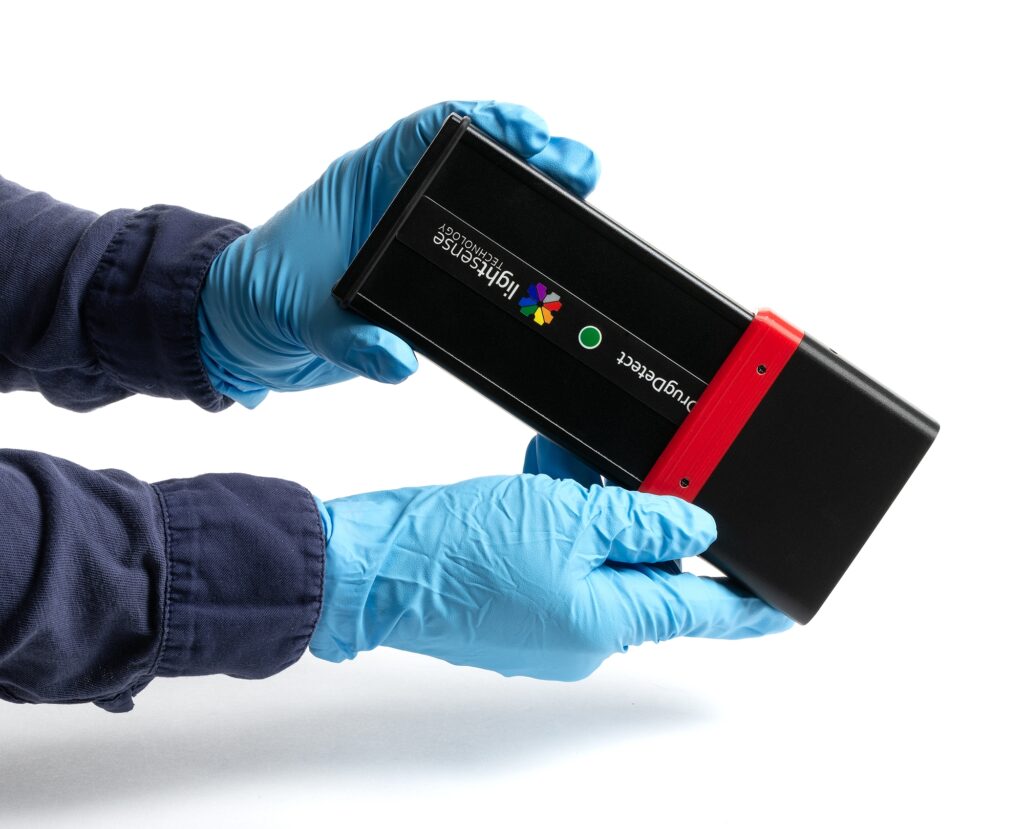
NYC Corrections has bought multiple units of the DrugDetect-F1 to ensure officer safety in a dynamic environment.
August 13, 2025 – Tucson, AZ – Lightsense Technology is a Tucson-based startup focused on new multispectroscopic solutions to improve Public Health & Safety, from the Opioid crisis to Landmine detection, with a distinct focus on ease-of-use and frontline officer safety.
“We are proud to announce that the NYC Corrections Department has chosen to purchase our Drug Detect-F1 for use in their jails and security checkpoints. We believe that the Drug Detect-F1’s portability, ease of use, and small footprint makes it the perfect tool for cell searches and Special Operations in a dynamic environment”, noted Lightsense’s VP of Law Enforcement Operations, Lenny Lemer Muñiz, formerly Special Advisor to the Police Commissioner of the New York City Police Department (NYPD) and NY/NJ HIDTA Director.
“We are happy to share this initial success in broadening our market focus beyond the important first responder community, now also helping to serve the corrections environment, with fast, simple and inexpensive solutions to further officer safety in those settings as well”, commented Lightsense CEO, Terje Skotheim. “Lightsense’s breakthrough handheld spectroscopy technology, the DrugDetect-F1, helps law enforcement officers, and our entire law enforcement community, stay safe, while providing a fast, inexpensive, and easy to use high tech tool for quickly identifying powder methamphetamine or fentanyl samples, safely, through plastic wrap or thin, transparent polyethylene bags”.
The DrugDetect-F1 (or DDF1) is:
Affordable – Designed with public safety budgets in mind to ensure wide accessibility.
Ultra-Compact – easily clipped onto uniforms, belts, or gear bags;
Durable & Field-Ready -built to withstand harsh environments and daily use, and
About Lightsense Technology
Lightsense has developed a groundbreaking multi-spectral technology platform, and miniature high-performance low-cost spectroscopic devices, for the rapid and easy detection of certain dangerous substances like fentanyl for law enforcement officers. It provides a compact and cost-effective solution designed to protect law enforcement officers and first responders from accidental exposure to fentanyl, while being the most sensitive fentanyl handheld detector on the market. Fentanyl exposure has become a serious risk for law enforcement across the country, and Lightsense Technology solutions are simple, inexpensive and can help improve officer safety. All Lightsense devices are designed, made & calibrated in the US.
About DrugDetect-F1:
The DrugDetect-F1 uses revolutionary multi-spectral technology. Operating with high levels of accuracy to detect large or trace amounts of illicit drugs (safely through thin transparent bags). This lightweight point-and-shoot detector can be easily used right in the field. Thus, improving safety and efficiency for Law Enforcement Officers and first responders, while reducing the risk of accidental exposure.
For more information about Lightsense products, visit lightsensetechnology.com/products.
Or, contact Lightsense’s CMO, Bruce Berkoff directly at (888) 736-7349, or bberkoff@lightsensetechnology.com.